


When you think of Costa Rica, you probably picture lush rainforests, tropical beaches, and incredible wildlife, but this paradise is also home to some of the most spectacular volcanoes on Earth. From the famous Arenal Volcano near La Fortuna to the towering Irazú Volcano in the Central Valley, each of Costa Rica’s volcanoes has its own personality, its own drama, and its own rewards for those who make the trip.
In this guide, we’ll walk you through the top volcanoes to visit in Costa Rica, starting with the ones closest to Skyfall Luxury Vacation Home in Playas del Coco, Guanacaste, and reaching all the way to the famous peaks near the capital city of San José. Whether you’re planning a day trip from the coast or a multi-day exploration of Costa Rica’s volcanic landscapes, this is your definitive resource.
Ready to feel the heat? Let’s explore the volcanic side of Costa Rica’s magic.
In This Guide
- Why Is Costa Rica So Volcanic?
- Best Volcanoes Near Guanacaste (Day Trips from Playa del Coco)
- Costa Rica’s Most Famous Volcanoes
- How Many Active Volcanoes Are in Costa Rica?
- What Is the Best Base for Exploring Costa Rica’s Volcanoes?
Why Are There So Many Volcanoes in Costa Rica?
Costa Rica is part of the Pacific Ring of Fire — the horseshoe-shaped zone of seismic and volcanic activity that encircles much of the Pacific Ocean. The country sits directly above the subduction zone where the Cocos Tectonic Plate dives beneath the Caribbean Plate, generating enormous geothermal energy that fuels the chain of volcanoes running along Costa Rica’s spine from Guanacaste in the northwest to the Central Highlands in the southeast.
This geological drama is what makes Costa Rica’s landscapes so extraordinarily varied and so endlessly fascinating. The volcanic activity that shaped these mountains also created the rich soils that make Costa Rica one of the most biodiverse countries on Earth. Costa Rica is home to over 200 volcanic formations, with five classified as currently active: Rincón de la Vieja, Poás, Turrialba, Irazú, and Arenal. The remaining major volcanoes, like Barva and Chato, are dormant or have been inactive for centuries.
One of the most remarkable facts about Costa Rica’s volcanoes is the density: researchers estimate one volcano every 35 kilometers along the Central Volcanic Range, a chain of volcanoes that forms one of the most concentrated volcanic corridors in the western hemisphere.
Are there active volcanoes in Costa Rica right now?
Yes, Costa Rica currently has five active volcanoes: Arenal, Poás, Rincón de la Vieja, Turrialba, and Irazú. Of these, Turrialba is the most frequently erupting, sitting at a Level 2 Warning status as of 2025.
The Best Volcanoes to Visit Near Guanacaste
Guests staying at Skyfall Luxury Vacation Home in Playas del Coco are perfectly positioned to explore the Guanacaste region’s volcanic wonders. The Guanacaste mountain range is home to some of the most exciting and accessible volcanoes in Costa Rica, all within a comfortable day-trip range of the coast. Here are our favorites.
Imagine Yourself Here
Wake up to ocean views, golden sunsets, and total privacy. Experience Costa Rica the way it was meant to be lived.
Rincón de la Vieja Volcano — The Active Adventure Park
Located in Rincón de la Vieja National Park, this is one of Costa Rica’s most active volcanoes and arguably the most entertaining to visit. Rincon de la Vieja rises to 1,916 meters (6,286 feet) above sea level in the heart of the Guanacaste region, and it has been erupting regularly in recent years, most notably a major eruption recorded in 2023. Rincón de la Vieja volcano remains one of the most visited volcanoes in Costa Rica, precisely because of its constant volcanic activity.
What makes Rincón de la Vieja so special as a day trip from the Guanacaste coast is the sheer variety of natural attractions packed into a single visit:
- Bubbling mud pools (pailas) — boiling volcanic mud pools that feel like something out of another world
- Fumaroles — steam vents releasing gas and sulfur, a vivid sign of the active volcano beneath
- Hot springs — geothermal pools fed by volcanic heat, perfect for a soak after a hike
- Waterfalls — including the stunning La Cangreja waterfall, surrounded by tropical forest
- Abundant wildlife — howler monkeys, coatis, toucans, and over 300 bird species have been recorded in the park
The hike to the active crater takes approximately 5–6 hours round-trip. The park is located about 1.5–2 hours from Playas del Coco, making it an ideal full-day excursion from Skyfall Luxury Vacation Home. Our concierge team can arrange guided tours, including transportation and park entry, so all you have to do is enjoy the journey.
Pro tip: Start your hike early in the morning — the volcanic landscapes are most dramatic before midday clouds roll in, and you’ll want the full afternoon to relax in the hot springs.

Miravalles Volcano — Costa Rica’s Hidden Hot Spring Gem
If Rincón de la Vieja is Costa Rica’s action-packed volcanic adventure park, Miravalles Volcano is its quieter, more contemplative cousin. Rising to 2,028 meters (6,654 feet) in the Guanacaste region, Miravalles volcano is actually the highest volcano in Guanacaste, though many visitors to the area never hear about it. That’s exactly what makes it so rewarding.
The slopes of Miravalles are home to Las Hornillas, a volcanic thermal field with bubbling mud pools, fumaroles, and geothermal hot springs. Costa Rica actually harnesses the geothermal energy of Miravalles through a power plant that generates a significant portion of the country’s electricity, making it a fascinating intersection of natural wonder and sustainable energy.
For those seeking a less crowded, more off-the-beaten-path experience, Miravalles is a beautiful alternative to the busier volcanoes. The thermal baths here are excellent, the scenery is lush, and the drive through the agricultural heartland of Guanacaste is a lovely journey in itself.
Tenorio Volcano National Park — Home of the Legendary Río Celeste
Tenorio Volcano National Park is one of the most photogenic and surprising destinations in Costa Rica, and one of the top volcanoes to visit in the country. The park is best known as the home of Río Celeste, a river with an impossibly vivid turquoise-blue color created by volcanic minerals interacting with the water. The color is so surreal that legend says God washed his paintbrushes here after painting the sky.
While Tenorio volcano itself is less frequently active than Rincón de la Vieja, the volcanic geology of the region is very much alive in the form of fumaroles, hot springs, and the entire hydrothermal system that feeds Río Celeste. The park also offers:
- A volcanic hot spring pool in the middle of the jungle
- Cloud forest trails with incredible biodiversity
- A series of beautiful waterfalls along the Río Celeste
- Excellent birdwatching, including chances to spot the resplendent quetzal
Tenorio is approximately 2.5–3 hours from Playas del Coco, making it a longer day trip. We recommend combining it with a night at a nearby lodge or reaching out to our concierge team to plan the logistics. It is well worth the journey — Tenorio remains one of Costa Rica’s best-kept secrets.

What Are the Most Famous Volcanoes in Costa Rica?
Beyond the Guanacaste region, some of the most visited volcanoes in Costa Rica are a few hours’ drive from the coast. These iconic peaks are well worth the trip — whether you’re into dramatic crater views, world-class hiking, geothermal hot springs, or simply crossing must-see spots off your Costa Rica volcanoes map. Here are the most famous volcanoes in Costa Rica and what makes each one extraordinary.
Arenal Volcano — Costa Rica’s Most Iconic Active Volcano
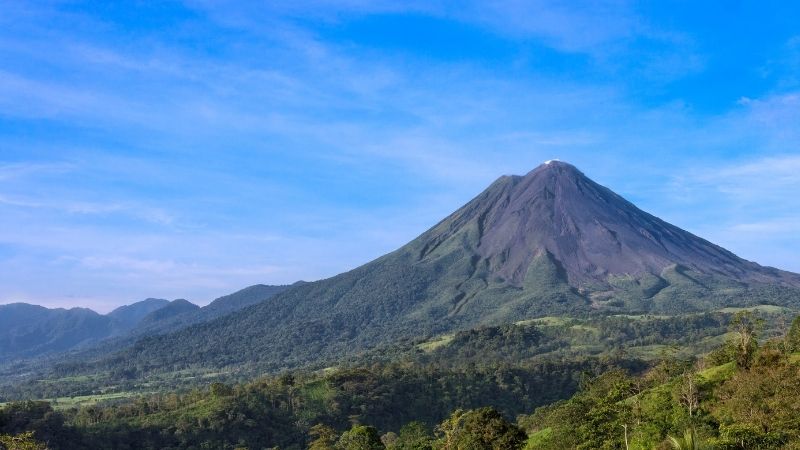
No list of volcanoes in Costa Rica would be complete without Arenal. Standing at 1,670 meters (5,479 feet) near the nearby town of La Fortuna, Arenal Volcano is one of the most perfectly conical stratovolcanoes in the world, and one of the most photographed. Arenal remains one of the most visited volcanoes in Costa Rica and continues to draw travelers from around the world to the shores of Lake Arenal.
Though Arenal’s last major eruption occurred in 2010, when it entered a resting phase, it remains an active volcano with ongoing geothermal energy, fumaroles, and, most importantly for weary travelers, some of the best hot springs in Costa Rica right at its base. The volcanic heat from Arenal naturally warms the thermal pools at Tabacón, Baldi, and several other resort-style hot spring complexes around La Fortuna.
Which is the tallest volcano in Costa Rica?
Irazú Volcano is the tallest volcano in Costa Rica, reaching 3,432 meters (11,260 feet) above sea level. It is also the highest active volcano in Central America.
Why is Arenal Volcano so special?
- The near-perfect cone is one of the most beautiful volcano shapes on Earth
- Arenal Volcano National Park surrounds the cone with over 12,000 hectares of primary forest
- Lake Arenal, created by a dam, provides spectacular foreground reflections of the volcano
- World-class zip-lining, white-water rafting, and hanging bridges are available right in the area around Arenal
- La Fortuna Waterfall, a 75-meter cascade, is just 15 minutes from town
Arenal is about a 3.5–4 hour drive from Playas del Coco. We recommend staying overnight in La Fortuna to make the most of your visit — the town of La Fortuna is charming, welcoming, and packed with great restaurants and adventure options. Ask our concierge team to help arrange a seamless Arenal adventure from Skyfall.
Poás Volcano National Park — One of the World’s Largest Active Craters
Located just north of the capital city of San José and easily accessible from the Central Valley of Costa Rica, Poas Volcano is one of the most active volcanoes in the country, and one of the most accessible. Poás Volcano National Park offers visitors the rare experience of walking up to the very edge of a massive, actively fuming crater without a strenuous hike.
The numbers alone are stunning: Poás Volcano’s main crater is nearly a mile wide (around 1.5 km in diameter), making it one of the largest active volcanic craters in the world. Within the crater sits a hyperacidic crater lake, one of the most acidic natural bodies of water on Earth, that periodically erupts with jets of sulfuric mud and gas. The views from the crater rim on a clear day are nothing short of extraordinary.
Poás also has a second, dormant crater called Botos, which contains a beautiful emerald-green crater lake surrounded by cloud forest. The contrast between the two craters — one violently active, one serene and forested — captures the dramatic duality of Costa Rica’s volcanic landscape.
Key facts about Poás Volcano:
- Elevation: 2,708 meters (8,885 feet) above sea level
- Crater diameter: ~1.5 km — one of the largest active craters in the world
- Last major eruption: 2018, which temporarily closed the park
- Distance from San José: Approximately 1.5 hours — perfect for a day trip from the capital
- Best visit time: Early morning during the dry season (December–April) for the clearest crater views
Note that visits to Poás Volcano National Park require advance reservations through the SINAC national parks booking system, and the park has capacity limits to protect the ecosystem and manage visitor safety. It is one of the most popular volcanoes to visit in Costa Rica, so book early.
Irazú Volcano National Park — The Tallest Volcano in Costa Rica
Irazú Volcano is the highest volcano in Costa Rica, rising to an impressive 3,432 meters (11,260 feet) above sea level. earning it the nickname “El Coloso” (the Colossus). Irazú is the tallest volcano in Costa Rica and the tallest active volcano in all of Central America. It’s located in the Cordillera Central, just 60 km from San José, and has a fascinating. and sometimes terrifying. volcanic history.
On a clear day, the summit of Irazú Volcano offers one of the most astonishing views in Costa Rica — you can see both the Pacific Ocean and the Caribbean coast simultaneously, a perspective that makes the volcanic drama of this tiny country viscerally clear. On most days, however, the summit is cloaked in clouds and mist, which gives it an eerie, otherworldly atmosphere all its own.
What makes Irazú Volcano worth visiting:
- The tallest volcano in Costa Rica, at 3,432 meters (11,260 feet) above sea level
- Five distinct craters, including the Diego de la Haya crater lake
- A paved road leads almost to the summit — no strenuous hiking required to reach the crater rim
- The lunar-like volcanic landscape inside the crater complex is unlike anywhere else in Costa Rica
- On rare clear days, simultaneous views of both the Pacific and Caribbean coasts
Irazú Volcano National Park is open daily from 8:00 AM to 3:30 PM. The park is located about 30 km from Cartago and approximately 1.5–2 hours from San José, making it one of the most convenient day trips in the Central Valley of Costa Rica.
Are the volcanoes in Costa Rica safe to visit?
Yes, Costa Rica’s volcanoes are generally safe to visit, and millions of tourists do so every year. The country’s national parks system and OVSICORI-UNA (the Volcanological and Seismological Observatory) continuously monitor all active volcanoes and will close parks or restrict access when volcanic activity increases beyond safe levels.
Turrialba Volcano — Costa Rica’s Most Actively Erupting Volcano
If you want to witness raw volcanic activity in real time, Turrialba Volcano is Costa Rica’s most compelling choice. Rising to 3,340 meters (10,958 feet) in the Cartago Province, Turrialba is the second-highest volcano in Costa Rica and one of the most active volcanoes in the world. The last confirmed eruption occurred in 2022. A phreatic eruption was recorded in March 2025, and the volcano currently maintains a Level 2 Warning status under continuous monitoring by OVSICORI-UNA.
Visiting Turrialba Volcano National Park:
- The park reopened in December 2020 after years of closure due to eruptions
- All visits must be with a certified guide — no independent hiking is permitted due to ongoing volcanic activity
- Guided tours run from 6:00 AM to 10:00 AM
- A 4WD vehicle is mandatory on the mountain roads to the Tapojo entrance
- The park may close during significant volcanic events; always confirm before visiting via OVSICORI-UNA
- On clear days, panoramic views stretch across the Caribbean plains, Irazú, Poás, and Barva Volcano
The town of Turrialba is approximately 44 miles (71 km) east of San José and serves as the gateway to the volcano. If you’re an adventure seeker with a high tolerance for frontier conditions, a guided Turrialba summit hike is one of the most visceral volcanic experiences Costa Rica offers.
Barva Volcano — Cloud Forest Hiking in Braulio Carrillo
Barva Volcano may be one of the least-visited volcanoes in Costa Rica, but it is a gem for serious hikers and cloud forest lovers. Located within Braulio Carrillo National Park, Barva Volcano rises to 2,906 meters (9,534 feet) above sea level in a landscape draped in misty, primary cloud forest. Unlike the dramatic craters of Poás or the towering heights of Irazú, Barva’s craters are now filled with serene lagoons — tranquil, emerald-green pools surrounded by ancient trees dripping with moss and bromeliads.
The hike to Barva Volcano’s summit is one of the most rewarding in Costa Rica for nature lovers. The trail passes through some of the most pristine and biodiverse cloud forests in the country, with excellent chances of spotting tapirs, resplendent quetzals, and a dazzling array of cloud forest birds. The landscape is moody, mysterious, and feels genuinely wild.
Barva is accessible from Heredia, about 1.5 hours from San José. The trails are well-maintained but can be muddy and cold — come prepared with layers and waterproof gear. Because of its lower visitor numbers, Barva is a wonderful choice for travelers who prefer solitude over crowds.
Chato Volcano — The Emerald Crater Lake Hidden Beside Arenal
Most visitors to the Arenal area walk right past Chato Volcano without realizing it’s there, and that’s a shame, because Chato is one of the most rewarding hikes in Costa Rica. Chato is a dormant volcano that sits directly beside Arenal, and its summit crater is home to a stunning, impossibly clear crater lake surrounded by lush jungle.
The hike up Chato is steep and can be muddy, but the payoff at the top — a secluded, emerald-green lake reflecting the surrounding rainforest — is exceptional. The hike typically takes about 2–3 hours each way and offers beautiful views of Arenal Volcano’s perfect cone throughout the ascent. Because Chato is less promoted than Arenal itself, the trail tends to be quieter and more intimate.
Chato Volcano is typically accessed from the La Fortuna / Arenal area and can be combined with other activities in the Arenal zone as part of an overnight trip.
How Many Active Volcanoes Are in Costa Rica?
Costa Rica has five officially active volcanoes: Arenal, Poás, Rincón de la Vieja, Turrialba, and Irazú. In geological terms, “active” means the volcano has erupted within the last 10,000 years and shows ongoing signs of activity, including fumaroles, seismic events, gas emissions, or recent eruptions. Of these five, Turrialba is currently the most frequently erupting, followed by Poás and Rincón de la Vieja.
Beyond the five active volcanoes, Costa Rica has several dormant volcanoes that last erupted in the more distant past — including Barva, Chato, Miravalles, and Tenorio. These are considered part of the broader chain of volcanoes that characterizes this active region in the western edge of the Caribbean Plate.
Exploring Costa Rica’s Volcanoes? Stay at Skyfall Luxury Vacation Home
Where you stay in Costa Rica shapes which volcanoes you can realistically visit. If your goal is to experience as many of Costa Rica’s volcanic wonders as possible, including the Guanacaste volcanoes and the famous peaks near San José, then Playas del Coco in Guanacaste is an excellent home base.
Skyfall Luxury Vacation Home in Playas del Coco offers the perfect blend of luxury and location for volcano explorers. With 4,000+ square feet of indoor/outdoor living space, panoramic Pacific Ocean views, a private pool, and full concierge services, you’ll have everything you need to rest and recharge between adventures.
Our concierge team can arrange guided day trips to Rincón de la Vieja, private transportation for multi-day volcano itineraries, activity bookings, and more. We handle the logistics; you just enjoy Costa Rica’s beauty.
Ready to explore the volcanoes of Costa Rica? Book your stay at Skyfall Luxury Vacation Home and let our team plan your ultimate volcanic adventure.


