


The plane door opens, and the air hits you first. Warm, thick, a little sweet. Somewhere past the tarmac, a howler monkey is making a noise that sounds nothing like a monkey and a lot like a jaguar.
These Costa Rica travel tips exist because almost 3 million people had that same moment last year. Costa Rica welcomed nearly 2.9 million international visitors in 2025, according to the country’s Tourism Institute, and most of them arrived with some version of the same questions. Is it safe? Is it expensive? What do I actually need to know before I go?
Here’s what this guide actually covers, without the recycled advice you’ve probably already read:
Let’s start with the question everyone asks first.
Is Costa Rica Safe? The Honest Answer for First-Time Travelers
Yes, Costa Rica is safe for the vast majority of travelers, with the same practical precautions you’d use in any unfamiliar place. The U.S. State Department currently lists Costa Rica at a Level 2 travel advisory, which sounds alarming until you know that France, Germany, and Italy carry the exact same rating.
What the Data Actually Shows
The real risk in Costa Rica is petty theft, not violence. Unattended bags on the beach, valuables left visible in a parked car, that sort of thing. Guanacaste and the Pacific coast, including Playas del Coco, tend to be more relaxed than San José or busier party towns further south. That doesn’t mean zero risk. It means normal city-level awareness goes a long way.
Simple Precautions That Actually Matter
Don’t leave any valuables visible in a rental car, even for five minutes at a trailhead or gas station
Stick to well-lit areas at night, especially when walking on the beach after dark
Use licensed red taxis or a reputable rideshare rather than unmarked cars
Don’t carry large amounts of cash, since most restaurants and shops take cards
Can I drink the tap water in Costa Rica?
Yes, in most tourist areas, including San José and Guanacaste. Tap water goes through municipal treatment and is generally safe. In more remote or rural areas, bottled or filtered water is the safer call.
What Costa Rica Actually Costs (It’s Not What You Think)
Costa Rica stopped being a bargain destination years ago. The colón has strengthened against the dollar, and import taxes on vehicles, fuel, and imported goods push everyday prices higher than most first-timers expect.
Why Prices Have Climbed
Tourism now makes up roughly 8% of Costa Rica’s GDP, and that growth has brought more infrastructure, but also more demand on a small supply of hotels, villas, and restaurants near the coast. A strong currency and rising operating costs get passed straight to visitors.
Realistic Daily Budgets
Meals: A casual soda meal runs $8 to $12 per person, while a sit-down dinner on the coast is closer to $25 to $45 per person
Activities: Guided tours and excursions typically range from $60 to $150 per person
Lodging: This is where group size matters most. A private villa split among a family or group often works out to a lower per-person cost than booking several hotel rooms, especially once you factor in a shared kitchen and a concierge team who can coordinate everything for you. Our villa versus hotel comparison breaks down the real numbers.
The Best Time to Visit Costa Rica, and Why Rainy Season Gets a Bad Rap
Costa Rica’s dry season runs December through April, and its rainy or green season runs May through November. Most guides stop there, which is exactly why so many travelers avoid a season they’d actually enjoy.
Dry Season on the Pacific Coast
Guanacaste sits inside what locals call the dry corridor, a stretch of the Pacific coast that gets noticeably less rain than the Caribbean side or the central mountains. Skies stay clear more often here, even outside the peak dry season.
Green Season Isn’t What You Think
Rain in the green season usually means a sunny morning, a short afternoon downpour, and a clear evening. It’s rarely an all-day washout. Crowds thin out, prices drop, and the rainforest turns a deep, saturated green that the dry season never quite matches.
Getting Around Costa Rica: Roads, Rentals, and What Nobody Warns You About
Getting around Costa Rica is where most first-timers get caught off guard. Roads here don’t always match the smooth highways travelers expect from home.
The Reality of Costa Rican Roads
Potholes are common even on main routes, and the last stretch to many beach towns is unpaved. A 4WD or high-clearance vehicle isn’t a luxury on those roads; it’s the difference between arriving on time and getting stuck. Driving after dark is strongly discouraged, since roads are poorly lit and livestock or pedestrians can appear with no warning.
Flying Into San Jose vs. Liberia
Most international flights land in San Jose’s Juan Santamaria Airport, but if your trip is Guanacaste-based, flying into Liberia’s airport instead saves hours of driving on the roads described above. It costs a little more on some routes, but the time saved is usually worth it for a coastal stay.
Car Rental in Costa Rica vs. Private Transfers
Car rental in Costa Rica gives you the freedom to explore on your own schedule, but it comes with mandatory insurance costs that often surprise travelers at the counter. A private airport transfer skips the negotiation entirely. For a Guanacaste-based trip, our guide on how to get to Playa del Coco lays out every option from Liberia’s airport.
Visiting Costa Rica for the First Time? Here’s What to Pack for the Pacific Coast
Going to Costa Rica means packing for two climates in one trip, since a single day can move from jungle humidity to beach sun to an evening breeze that actually calls for a light layer.
The Essentials
Reef-safe sunscreen: not currently required by national law, but strongly encouraged around reefs and marine parks, and it’s worth bringing from home since local options run expensive
A reusable water bottle since tap water is safe to drink in most tourist areas, including Guanacaste, which cuts down on plastic waste
A waterproof bag for boat tours, waterfalls, and any beach day where a rogue wave is a real possibility
Lightweight layers and good sandals that can go from a rainforest trail to a beach club without a wardrobe change
A universal power adapter, though Costa Rica uses the same plug type as the US and Canada, so this one is often unnecessary
Staying at a well-equipped villa also cuts down on how much you need to pack in the first place, since laundry and basic amenities are usually already on hand.
What are some common travel mistakes to avoid in Costa Rica?
Renting a sedan for roads that need 4WD, underestimating drive times because of potholes and unpaved stretches, not carrying any cash for smaller sodas and rural stops, and booking excursions last minute during dry season when spots fill up fast.
Costa Rica Practical Advice: SIM Cards, Wi-Fi, and Staying Connected
Traveling to Costa Rica without a plan for connectivity is one of the more avoidable headaches of the whole trip. Wi-Fi in Guanacaste hotels and villas is generally solid, but cell coverage can drop out on rural roads and in the mountains.
Getting Connected on Arrival
Local SIM cards from Kolbi, Claro, or Movistar are available right at Liberia’s international airport and are usually the cheapest option for a longer stay
eSIMs can be set up before you leave home, which is convenient if you land late and don’t want to hunt for a kiosk
Offline maps through Google Maps or Maps.me are worth downloading in advance, since the GPS signal can be unreliable on unpaved backroads
Is it safe to travel to Costa Rica right now?
Yes, for the vast majority of visitors. Petty theft is the most common issue, not violent crime, and popular tourist regions like Guanacaste tend to be more relaxed than urban centers.
Currency, Tipping, and Paying Your Way in Costa Rica
Costa Rica’s local currency is the colón, though US dollars are accepted almost everywhere in tourist areas, including Guanacaste. Cards work in most restaurants and shops, but it’s worth carrying some colones for small purchases and rural stops.
Colones, ATMs, and Getting Cash the Smart Way
Withdraw colones from bank-affiliated ATMs rather than standalone machines, which tend to carry higher fees. Many Costa Ricans speak at least some English in tourist areas, so paying and asking questions rarely require more than a few words of Spanish.
Tipping Culture in Costa Rica
A 10% service charge is often already built into restaurant bills, so an additional tip is appreciated but not expected. Tour guides typically receive $5 to $20 per person depending on the length of the excursion, and villa or hotel staff appreciate a small tip at the end of a stay for the same reason you’d tip anywhere else in the world.
Visa and Entry Requirements for US and Canadian Travelers
US and Canadian passport holders can enter Costa Rica visa-free for up to 90 days. A few entry details are easy to overlook.
Passport validity: most airlines require at least one day of validity remaining, though it’s safest to travel with several months left before expiration
Proof of onward travel: immigration officers can ask to see a return or connecting flight
Travel insurance: increasingly expected, and worth having regardless
Requirements can shift, so it’s worth checking current rules directly with official sources before you fly.
Do you need a car to get around Costa Rica?
Not necessarily. Many travelers rely on private transfers or domestic flights between regions instead of renting a car, especially if their trip is based in one area like Guanacaste.
Top Things to Do in Costa Rica (Beyond the Obvious)
Arenal and Manuel Antonio National Park get most of the attention, and for good reason. But Guanacaste has its own set of hidden gems that don’t show up on every top ten list.
Pacific Coast vs. Caribbean Coast: Which Fits Your Trip
Costa Rica’s Pacific coast, where Guanacaste sits, tends to be drier, easier to reach, and home to most of the country’s resorts and villas. The Caribbean coast moves more slowly, rains more, and has a distinct Afro-Caribbean culture and cuisine. Most first-time visitors gravitate toward the Pacific side for the reliable weather alone.
Guanacaste’s Underrated Experiences
Rincon de la Vieja for volcanic mud baths and hiking without the Arenal-sized crowds
The Catalina Islands for snorkeling among rays, reef fish, and the occasional white-tip shark
A sunset cruise from Playas del Coco, one of the more relaxed ways to see the coast
Sport fishing charters out of Coco or nearby Ocotal, popular with anglers chasing marlin and sailfish
Wherever you go, a local tour guide makes a real difference. Exploring the rainforest without a guide means you’ll walk right past the sloth curled in the branches above you. And if beach time is more your speed, our roundup of the best beaches in Costa Rica covers the standouts beyond Guanacaste.
Costa Rican Food Culture: What to Eat, Drink, and Seek Out
Gallo pinto shows up at nearly every breakfast table, a simple mix of rice and beans that somehow tastes completely different from one soda to the next. Ceviche along the Pacific coast is often the freshest seafood you’ll eat on the trip. For something stronger, a guaro sour is the unofficial drink of Costa Rica, and fresh tropical fruit juices are everywhere once you know to ask for them.
The difference between a soda and a tourist restaurant matters more than the price tag suggests. Sodas are small, family-run spots serving traditional Costa Rican food at local prices, and they’re often where you’ll get the best meal of your trip.
Eco-Certified Lodging and Sustainable Travel in Costa Rica
Costa Rica’s Certificate for Sustainable Tourism, known as CST, is a government program that rates hotels, tour operators, and other tourism businesses on their environmental and social practices. Looking for the CST logo is a simple way to make sure your stay actually supports the ecosystems you came to see, rather than just claiming to. Our guide to Costa Rica’s ecological tourism covers more ways to travel responsibly.
Is Costa Rica expensive to visit?
It’s pricier than its budget-destination reputation suggests. Expect mid-range daily costs similar to a US coastal vacation, with luxury villas and eco-lodges at the higher end.
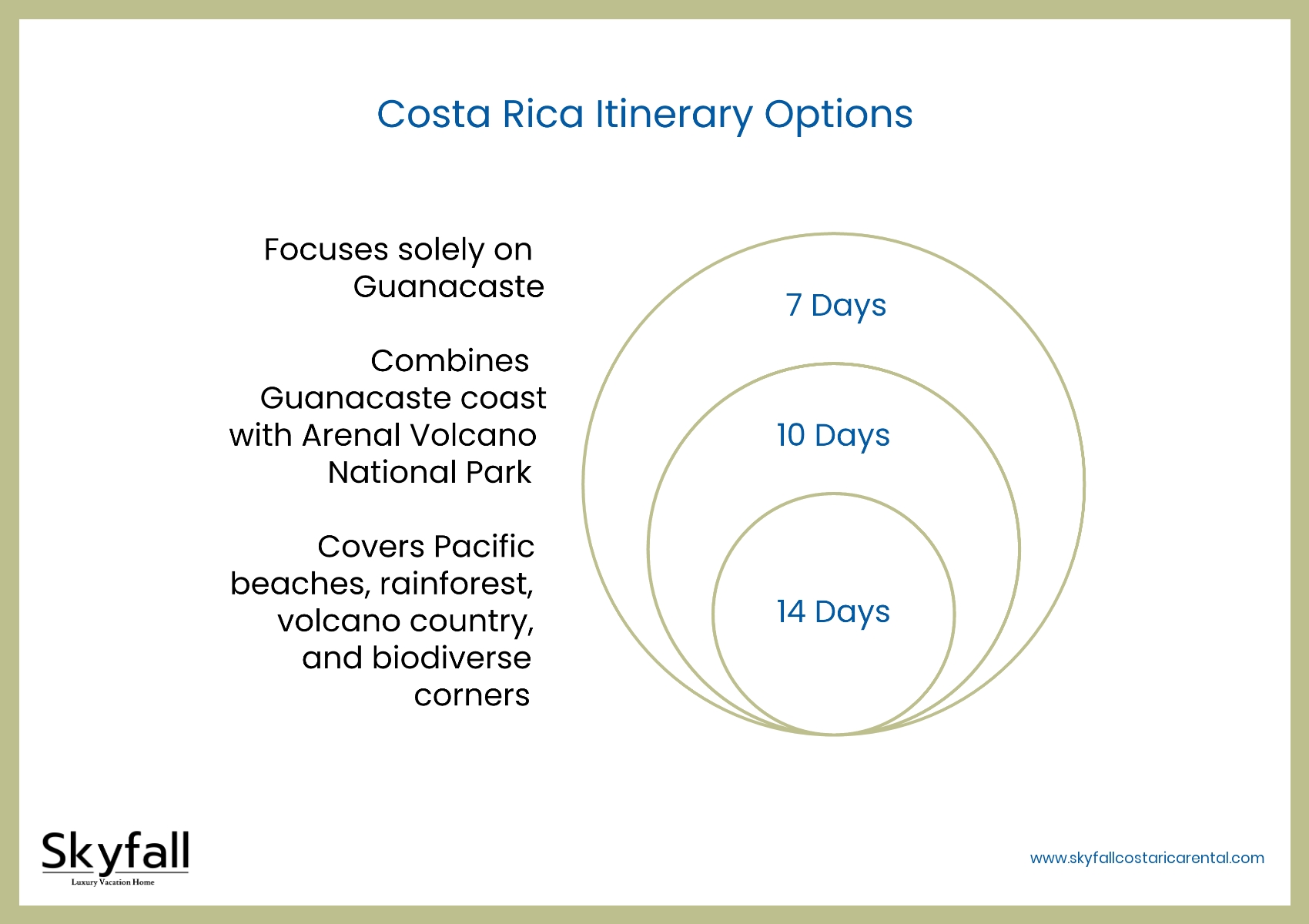
Sample Costa Rica Itineraries: 7, 10, and 14 Days
7 Days: Guanacaste Only
Base yourself in or near Playas del Coco for the full week. Split your time between beach days, one inland excursion like Rincon de la Vieja, and a sunset cruise or fishing trip. No long transfers, no packing and repacking.
10 Days: Guanacaste Plus Arenal Volcano National Park
Spend five or six days on the Guanacaste coast, then head inland to Arenal for hot springs, waterfalls, and volcano views. The contrast between beach and cloud forest is a big part of what makes Costa Rica memorable.
14 Days: Manuel Antonio National Park, Monteverde, and Beyond
Add Manuel Antonio National Park or the Osa Peninsula to the Guanacaste and Arenal combination, with a detour through Monteverde’s cloud forest along the way. This version covers Pacific beaches, rainforest, volcano country, and one of the most biodiverse corners of the country, all without feeling rushed.
Travel Insurance for Costa Rica: Why It’s Worth the Extra Step
Standard travel insurance policies often exclude adventure activities like zip-lining, ATV tours, surfing, and white-water rafting, which happen to be exactly what draws a lot of travelers to Costa Rica in the first place. Look for a policy that explicitly names adventure sports coverage rather than assuming it’s included.
Medical evacuation coverage is also worth the extra cost given how remote some national parks and beach towns are. It’s not the most exciting line item to think about while planning a trip, but it’s the one you’ll be glad you didn’t skip if something goes wrong.
Making Your Trip to Costa Rica Truly Unforgettable
Every good set of Costa Rica travel tips eventually comes back to the same idea: pura vida isn’t a slogan on a T-shirt; it’s an actual mindset. Slow down. Let the ferry run late. Let the rain pass before you decide the day is ruined.
The travelers who leave Costa Rica already planning their next trip are usually the ones who have stopped trying to control every detail. That’s easier to do when the logistics are already handled.
If you’d rather spend your trip watching the sunset than researching rental car insurance, Skyfall Luxury Vacation Home’s concierge team in Playas del Coco can plan the details around you, from private transfers to excursion bookings to a private chef on your last night.
Ready to see Guanacaste for yourself?
Skyfall Luxury Vacation Home puts you close to the beach with a concierge team that knows the area inside and out.


